Friday, 3 October 2014

Stair case to the moon, liquorice hermit crabs and open cut mines……….


The big blue at Broome……….


Wow……we finally made it to the big blue or to be more accurate, some ocean where we can finally immerse ourselves! Well this isn’t strictly true as there is still the risk of crocs, stingers and sharks but hey, do what the locals do. True to form, on our first visit to Cable beach “snake charmers Hopkins” had another interaction with a 1.5 metre brown snake! 

It was great to finally see the turquoise blue of the ocean at Broome. We camped at Roebuck Beach caravan site for some washing and recovery from the Gibb in preparation to see the staircase to the moon. This is a phenomenon which happens about 6 times per year on full moon tides. We are talking up to 11.5 metre tides! As the moon rises in the East it throws light and shadows over the tidal flats of Roebuck estuary giving the illusion of “stairs to the moon”. Quite an amazing wonder of nature which happened for two nights while we were in Broome.


After washing, shopping and enjoying Cable beach it was then time for the Hopkins family to head out of Broome in search of more ”free” bush camping on the Dampier Peninsula. This is the peninsula North of Broome which leads to Cape Leveque. On the lower west side there is a dirt road which has very red sand which passes various spots up to James Price Point. We explored this road until we could go no further and our path was stopped by a 700mm deep salt water crossing. This was a risk not worth taking for the preservation of “Nellie” and the risk of getting stuck with a rapidly rising tide. We had passed a lovely beach camp at a place called Quondong Point where we made camp for a week. We had quite a little community of various people we have met on our travels and had a ball kayaking, fishing from a little 3.1 metre tinny (thanks Shauny),body surfing and on one occasion some very small surf.


                                          Nico & Anita


                                          Kerry & Rosie


                                          Adrian, Ben & James


                                          Quondong Point Posse


Chased by a shark and eating hermit crabs………
One member of our little community was Nico the surfing German. Nico and I are kindred spirits whose company is always full of fun and action. Nico has quite an interesting accent when speaking English which is very endearing and frankly quite trusting and genuine.
Well to set the scene at night there are literally hundreds of hermit crabs wondering around the sand dunes. One evening well engrossed in conversation and reasonably lubricated with some fine artisan rum form Kununurra (thanks very much Kerry) Nico held out his hand and said (in his endearing way), “would you like some liquorice” of which I am a big fan. Well I said “yes please Nico” and promptly threw both pieces of liquorice into my mouth……….. To my absolute horror next thing I know the liquorice is attacking my bottom lip and seemed to be firmly attached. With a great deal of hilarity from the entire camp fire posse, I proceeded to try and pull two hermit crabs who in fear of their lives were attached to my bottom lip! Needless to say this was VERY funny and caused quite a lot of hilarity.
If that wasn’t enough there was to be more fun or should I say scary action with my old mate Nico the next evening whilst surfing on sun down. For those of you who don’t know surfing on sun down is not recommended as this is when Sharks can be on the prowl. I heard Nico shout shark and looked up to see a 250mm fin protruding from the water racing towards me. Weirdly I actually felt quite calm and not panicked. At the last moment the shark fin swerved away almost like it had realised that I wasn’t his usual prey. I have yet to identify the shark species but needless to say I caught the next wave in.
After the fun and excitement of Quondong Point it was time to say goodbye and head inland once more to catch up with friends in Newman.

Quondong to Newman………
We left Quondong point and headed down the coast to Port Hedland, having three overnight stops on the way, Barn Hill, Cape Keraudren and De Grey River.
Our plan was to travel the Great Northern Hwy to Newman via W.A’s second largest National Park- Karijini. The Hwy to Newman takes you through the central Pilbara, which is home to many Iron Ore operations. The road is busy 24/7 with hundreds of road trains transporting iron ore and supplies.

                                          Barn Hill Station


                                         Cape Keraudren


                                                       De Gray River


The Colours of Karijini…….

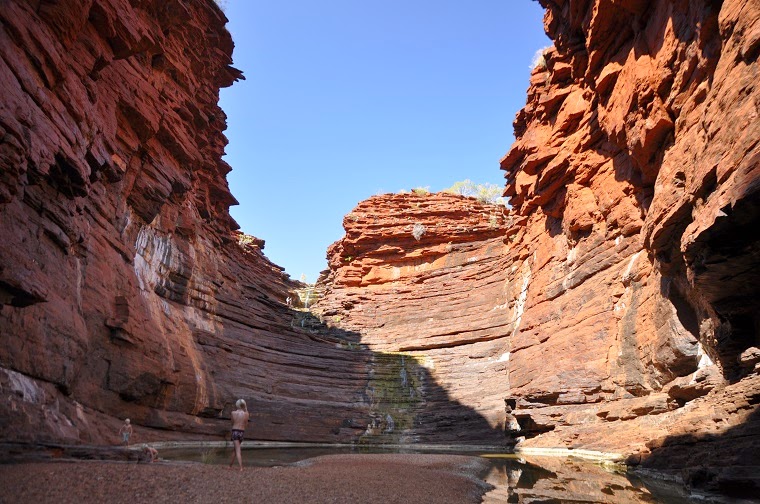
Once again we were blown away by the natural beauty of the country we live in, the sheer scale and the contrast in vibrant colour really takes your breath away. The banded iron ore formations exposed in and around the gorges originated more than 2.5 million years ago.
We had an extremely busy four days here, walking and exploring numerous gorges. The walks were all very challenging, involving steep descents, climbing and swimming. Our last day involved a 5am start were we managed to conquer four gorges in one day, pure madness, sore legs and very tired. The beer was well earned that day!!!


The wheels of Industry….
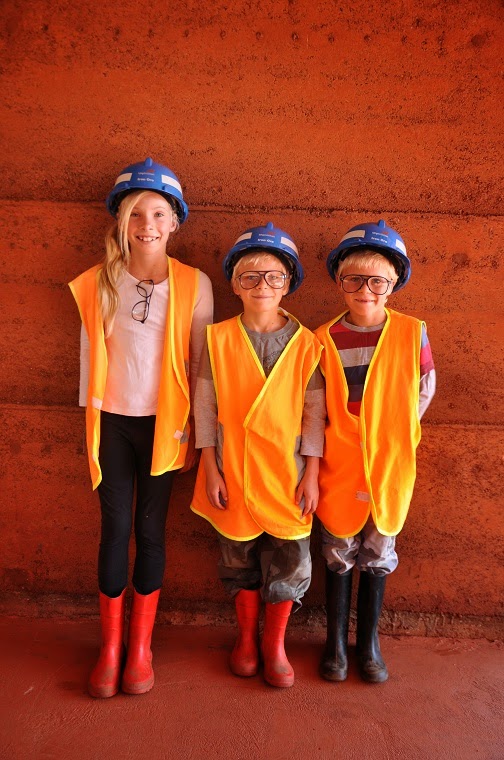
It was quite an eye opener travelling down the Great Northern Hwy and seeing firsthand the size and scale of the mining industry from Port Hedland to Newman. Whilst in Newman we visited Mount Whaleback open cut Iron Ore Mine. Mount Whale back is the largest single open cut Iron Ore mine in the world – currently 5.5 k’s long and 1.5 k’s wide. It has been mined for the last 40 years and is predicted to be for another 60.

A few facts and figures:
  • Iron Ore was first discovered by Stan Hilditch (founder of BHP Billington) in 1957 and mining commenced in 1967 after a Commonwealth Embargo was lifted.
  •  Type of Iron Ore mine is Brockman Hematite, which is one of the highest grades in the world.
  •  BHP’s railway is the longest privately owned railroad in the Southern hemisphere – 426 k’s
  •  The average train measures 3.75 k’s long, consisting of 6 locomotives, 336 ore cars and 1 driver.
  •   A loaded train ways approx. 42,000 tons can reach speeds of 65 kms/ph with a breaking distance of 3 k’s.


200 Tonne Wabco Ore Truck

·         Only 30 were produced, 22 were owned by mount Whaleback.
·         Carry’s a total weight of 20 tonne
·         When fully loaded, truck weighs 75 tonnes, more than the total of weight of a 747 jumbo jet.
·         In 1973 the trucks value was 2.5 million. It was sold to the visitors centre for $1.00.


We are currently stopped in Newman for a week, to hang out with our good friends Erica, Paddo,
  Arieh & Stella. We are now six months into our trip and running out of time so have decided to head from here straight to the coast, Exmouth and the delights of Ningaloo reef. Cheers for now Hoppo – hopkinsgowalkabout 2014


Saturday, 20 September 2014

The Kimberley.........Surviving the Gibb River Road


Hello peoples,

Again it has been a long break between blog updates but here we go…..Following a long wait in Kununurra for parts to repair “Nellie” we finally set off into the Kimberly to tackle the infamous Gibb River Road. It is hard to describe the beauty and enormity of the Kimberly. Public access really is limited when you look at the Kimberly as a whole (take a look at any map) due to the fact a great deal of the land is either Native Tile or private land. The very small slice we have seen just wets the appetite for more! Please read on and I will show you the little piece we have seen……..

Kununurra & Ord River Bush Camp


We had quite a long wait for parts at Kununurra and thus decided to explore locally and bush camp. We were fortunate to be guided to a few special spots one in particular on the Ord River near Mambi Island. This became our base for a week while we explored. The bush camp was off the old Kununurra –Wyndham rd., located in the Parry Creek Nature Reserve. The Reserve is home to various pieces of historical settlement and an important dry season billabong which is home to thousands of birds and a few “Salties”


Marlgu Billabong

The billabong comes into view from the Old Telegraph Hill where the old telegraph station remains are found. The billabong is a significant wetland area in the dry and is home to many bird species including, pelicans, Jacanas, pygmy geese, pied heron and many more. We definitely have some budding “twitchers” in the family losing a few hours without realising. Tilly Hopkins pinched the camera from dad and managed to grab the following images with our little 105mm lens.


Wyndham & the Grotto

Wyndham is Western Australia’s most northerly town which until 1985 had a large meat works but now is really a service centre for surrounding pastoral industries, mining, tourism and Aboriginal communities. Wyndham’s redeeming attraction is the Five Rivers lookout which is truly unique. The summit is reached after a winding drive from sea level to a height of 305metres. The peak offers views of five river mouths feeding into the gulf; Durrack, Kink, Pentecost, Forrest and the Ord River.

The Grotto is located a few kilometres from Kununurra. It is a small canyon on the way to Wyndham which is ideal for swimming. It is a natural amphitheatre with a 15 metre waterfall, although this was not flowing when we visited later in the dry season. 


The Gibb River Road

The Gibb River Road takes you through the heart of one of Australia's last wilderness frontiers - The Kimberley Region of Western Australia. The road travels from Kununurra to Derby, approximately 700 kilometres long and is infamous for being a vehicle wreaker and puncture king.
Travelling through this landscape is an awe inspiring experience as you pass age old rock formations, spectacular ranges, magnificent rivers, vast savannahs of bushland, steep cliff faces, and delightful gorges forged over millions of years by the power of nature.


Emma Gorge

This was to be our first stop which is not far from the start of the Gibb. Emma Gorge is a luxury bush resort owned by the famous El Questro Station (which sadly is now American owned). We did not camp here but did complete the Emma Gorge Walk which is quite fun and a bit of a scramble with a huge visual reward at the end of the Gorge. The Hopkins swam at the end even though the water temperature was a touch on the low side. We did find a natural hot spring running into the water hole which was welcome relief.


El Questro Station & Gorge

Despite the cost you simply have to visit El Questro as it is home to some truly spectacular scenery of the Kimberly. The rich and famous enjoy the luxury of the actual homestead where a stay starts at about $2000.00 per night for the ultimate in Kimberly luxury.
El Questro gorge walk was for me the most amazing walk of our trip to date. It is more of an adventure, rock scramble and waterfall climb than a walk. Many folks get halfway where they are confronted with two giant boulders which you have to swim too and then climb to access the second half of the adventure. We set off early to try and avoid people and get some great light for some photography. The images below really do not tell the full story but if you are on the Gibb this is a “must do” walk……..


Zebedee Hot Springs-El Questro

Zebedee hot springs is a thermal spring fed by a fault line from a permanent water supply deep into the earth. The water temperature is 28-30 degrees all year round. The surrounding cliff faces and scree runs are up to 1800 million years old! They are known as “King Leopold Sandstone”


Durrack River & Gibb River Camps and punctures…..

We had two memorable, out of the way bush camps which are only possible if you have the equipment to get there as most of the "Gibb" is Station or National Park camping. Technically “they” do not like you bush camping because you are always on somebodies land. Our stay on the Durrack was forced as we sustained our first puncture of the trip (in the camper trailer) and I got to use our tyre plugging repair kit in anger. This proved to be good training as I ended up repairing three more punctures for other people……good karma.
On our stay beside the actual Gibb River we set our “opera house” net and tried to catch more Cherabin  (a fresh water prawn) which is really great eating. To our dismay in the morning all bait and holder was gone, the victim of a large water monitor attack.


Barnet & Manning Gorges

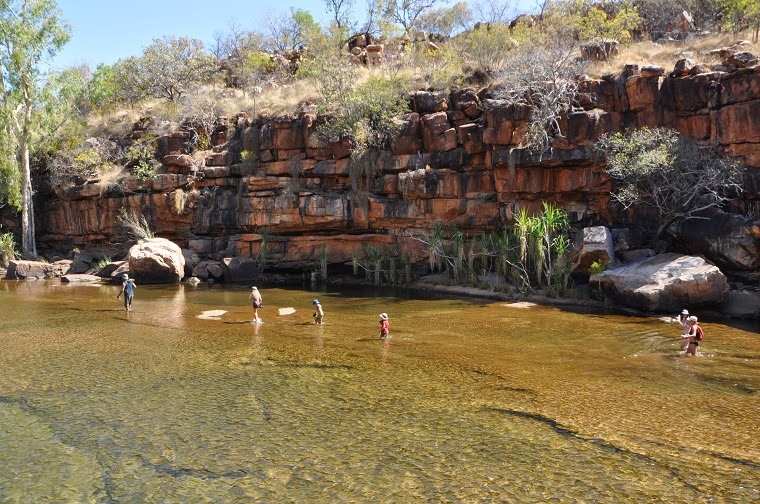
Barnett Gorge is a deep, wide river surrounded by spectacular pillared sandstone cliffs, and lush vegetation such as Pandanus Palms and Paperbark Trees. At the top of the river there are some cascading waterfalls, and rock pools. We met a lovely couple from Kununurra (Dan & Helen) who were up for some fun adventure and rather than doing the return walk we decided to adventure down the gorge down and out by finding our own route…not in the destruction manual but great fun. Being late in the dry season the river is not fast flowing and not as deep as it would be early in the dry season.
Manning gorge camp site is locate a 30 minute drive after Mt Barnett Roadhouse when heading north. This is about halfway along the Gibb 330km from Derby, or 375km from Kununurra. At the camp site there is a White 'sandy' beach which is pandanus lined waterway opening into a wide clear waterhole, only a short walk from the campsite. To get up to the gorge you need to cross the river, and then follow a trail leading to the top of gorge. The river crossing is done via a small tiny which can be pulled via a pulley system attached either side of the river. Tilly, Jack and Flynn became the ferry men for a fun filled day. The gorge has a waterfall plus a deep wide swimming hole surrounded by granite cliffs & rock outcrops.


Galvins & Bell Gorge

We met a great German couple at another bush camp after Manning gorge; Niko & Anita who are great value and seem to enjoy the kids company as well. Niko a keen surfer will probably surf the North West Coast with us. He is also quite the practical joker …..More on that in the next update.
Galvins Gorge is a deep water hole at the base of steep cliffs with a cascading waterfall earlier in the dry season. The walking trail leads straight to the mouth of the waterhole after a really short walk. This is a fun swim with a convenient rope swing left hanging by likeminded, fun loving people.
 Bell Gorge is located in the King Leopold Range conservation park. Bell Creek, was first discovered by Frank Hann in 1898 and named after an old Doctor from Derby. Bell Creek flows through the centre of this gorge. The main attraction is a cascading waterfall over 100 metres high. There is a deep swimming hole at the base of the waterfall, surrounded by shady ledges and high cliffs. The kids enjoyed some fun rock jumping here and the water was really warm as the gorge is very exposed to the sun.


Winjana Gorge and Tunnel Creek

Winjanna Gorge was formed 350 million years ago during the Devonian Period - During this time a sea covered this area and a line of barrier reefs formed for 1000km, eventually becoming the Napier Range. This is a limestone formation unlike most of the Kimberly which are sandstone. Windjana Gorge has been carved through the Napier Range, over millions of years by the Lennard River.
Originally named "Devil's pass" during Forrest's expedition through the Kimberley in 1883 because of the difficulties the party experienced crossing it. The current name is believed to be a corruption of the word "Wandjina" or the aboriginal spirit responsible for the wet seasons. Windjana Gorge is 3.5km long and has a current depth of 80 metres. The Lennard River flows through the centre of the gorge; a long winding river surrounded by steep Devonian reef cliffs and a wide variety of vegetation including Coolamon Trees, Leichardt Pine, figs, Melaleucas and grevilleas. Ancient sea fossil imprints and various deposits are visible on cliff walls. In summary it is just stunning!
100’s of fresh water crocs can be found sunning themselves on sand & in the water. On a previous. We were fortunate to find out about a rather strange occurrence which the ranger seemed to know nothing about (plus she was rather miserable, which is unusual for Park Rangers!). On dark literally thousands of fruit bats leave their daylight hideouts and pour down the gorge on dusk with some dropping to the water to drink. On doing this some get taken by the fresh water crocs. Again it is hard to put into words just how spectacular this was and unfortunately without better quality camera gear- hard to do justice too.

Tunnel Creek is a  deep Winding cave system filled with fresh water, carved 1 km long into the Oscar Range by Tunnel Creek. In 2007 rocks collapsed across the cave mouth which has made access harder. You now have to climb over 2 large boulders (partly submerged in water), to access the tunnel. There are sandy banks to walk across through most sections of the tunnel. You have to wade through water up to your knees in some sections. It is also very dark in places so our head torches were a must, plus there is the odd fresh water croc hiding in the dark which look like they are models as they sit incredibly still and are seemingly unfazed by human interaction.


We are now in Broome for a couple of nights after exploring the Dampier Peninsula north of Broome; more on that on the next update. I hope you enjoyed the images.
Cheers for now, Hoppo – Hopkins go walkabout 2014